
An accurate aluminium extrusion quote depends on clear and complete project information. When requesting pricing from aluminium suppliers in Sydney, details such as profile drawings, dimensions, alloy and temper, tolerances, finishes, fabrication requirements, quantities and delivery expectations help establish feasibility, pricing and lead times.
Extal works with clients to clarify these requirements and prepare quotations that reflect the intended application. This guide explains what to provide when requesting a quote for a standard or custom aluminium extrusion.
Profile Drawings and Dimensions
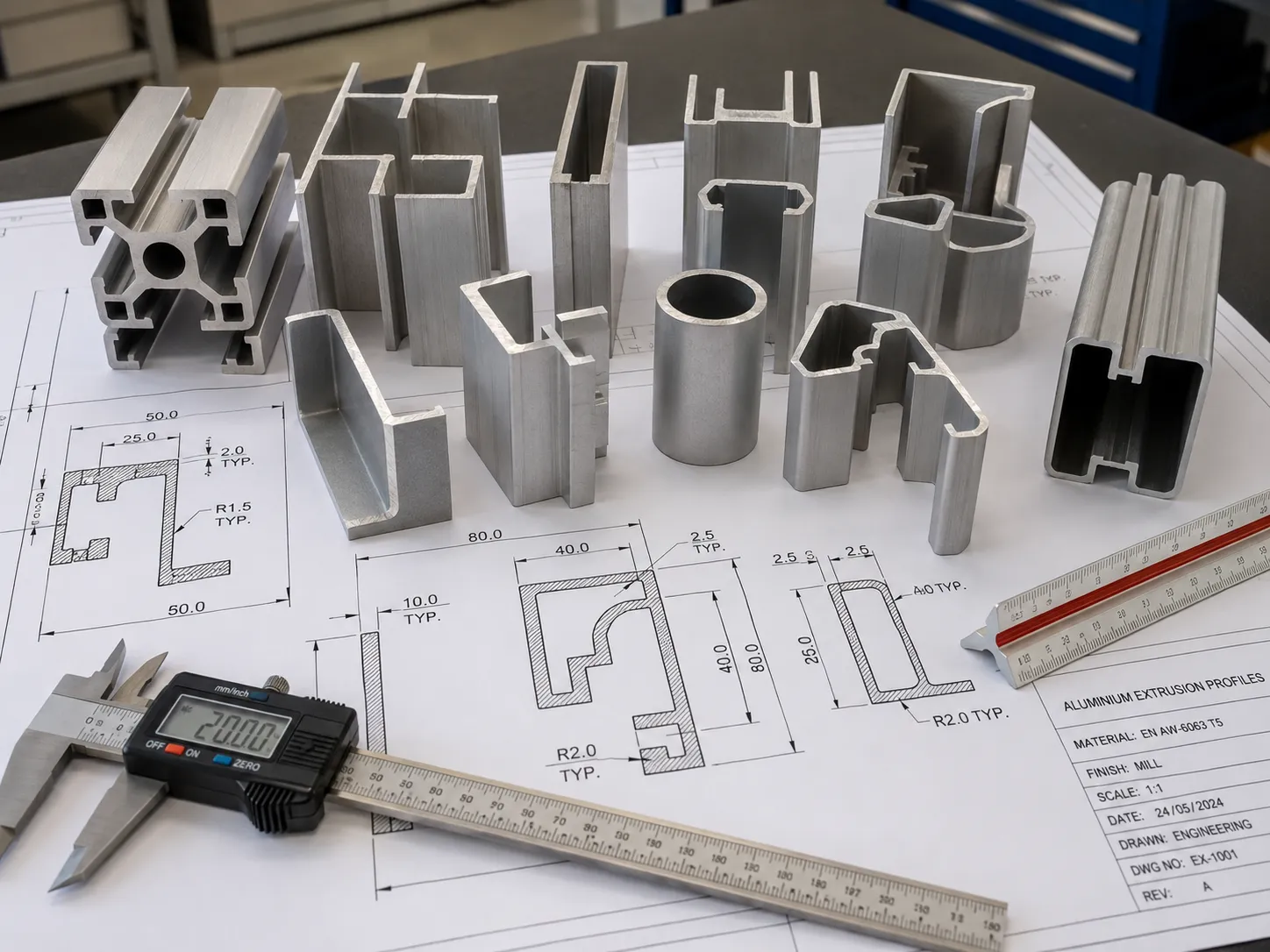
The profile drawing is the foundation of an aluminium extrusion quote. It allows the supplier or extrusion manufacturer to assess the section geometry, material usage, tooling requirements and suitability for production. Understanding how aluminium extrusion works also helps explain why profile size, wall thickness and design complexity can affect manufacturing requirements and cost.
Where possible, provide a dimensioned PDF, DXF or DWG drawing. A STEP file can also be included when a three-dimensional model is available.
What the Profile Drawing Should Show
The drawing should identify:
- Maximum profile width and height
- Wall thicknesses
- Hollow cavities and internal webs
- Channels, screw ports, slots and grooves
- Hooks, snap fits and other connecting features
- Mating, locating and sealing surfaces
- Small radii or details that may affect production
- Visible or presentation faces
- Critical dimensions and tolerances
Critical measurements should be marked clearly rather than left for the supplier to calculate or infer from the drawing. Visible surfaces should also be identified so cosmetic requirements can be considered when planning extrusion, handling and finishing.
Overall Size and Circumscribing Circle
The maximum width and height help determine the press capacity and die size required for the profile. These measurements are also used to calculate the circumscribing circle, which is the smallest circle capable of enclosing the complete cross-section.
Profile size can affect:
- Press and tooling requirements
- Weight per metre
- Material yield
- Extrusion speed
- Manufacturing feasibility
- Handling and transport
Providing the maximum dimensions directly reduces the risk of delays or incorrect assumptions during quotation.
Standard Profile or Custom Extrusion
One of the first decisions is whether the project can use an existing standard section or requires a custom extrusion.
This choice affects tooling costs, minimum order quantities, production planning and lead times.
Standard Profile or Custom Extrusion
Before requesting a quote, determine whether the project can use an existing standard section or requires a custom profile. This decision can affect tooling costs, minimum order quantities and initial lead times.
When a Standard Profile May Be Suitable
Standard profiles include commonly available angles, channels, tubes, bars, flat sections, framing profiles and trims. They can be a practical and economical option when an existing section meets the project’s dimensional and performance requirements.
For a standard-profile quote, provide:
- A product code, catalogue reference or profile drawing
- Required alloy and temper
- Supplied bar length
- Quantity
- Dimensional or straightness requirements
- Finish and fabrication requirements
Using an existing profile may avoid the cost and development time associated with new tooling. Minimum quantities and lead times will still depend on whether the section is held in stock, made to order or requires a dedicated production run.
When a Custom Extrusion May Be Appropriate
A custom extrusion may be suitable when no standard section provides the required shape, fit, performance or appearance. Custom profiles are used in applications such as architectural systems, machinery, enclosures, transport components, solar mounting systems and proprietary framing products.
A custom-extrusion enquiry should include:
- A fully dimensioned profile drawing
- A CAD model, where available
- Critical dimensions and tolerances
- Required alloy and temper
- Visible and cosmetic surfaces
- Target weight per metre, if known
- Initial and expected annual quantities
- Order frequency
- Finish and fabrication requirements
Custom tooling generally involves an initial die cost and a longer first-order lead time. However, a well-designed profile may reduce later machining, fastening, assembly and material waste by combining several functions within one section.
Sharing realistic production volumes and performance requirements helps Extal assess whether an existing profile or a custom solution is likely to offer better overall value.
Alloy, Temper and Intended Application
The quotation request should identify the required aluminium alloy and temper where these have already been specified. They influence strength, corrosion resistance, formability, machining, finishing and cost.
If the alloy has not yet been selected, explain how the extrusion will be used. This gives the supplier the information needed to discuss suitable and available options. Final material selection remains particularly important for structural or safety-critical applications.
Common Alloys Used for Extrusions
Many architectural and general-purpose extrusions use 6000-series alloys because they provide a useful balance of strength, corrosion resistance, formability and finish quality.
Common examples include:
- 6060 and 6063 for architectural profiles, glazing systems, frames and decorative sections
- 6005A, 6061, 6082 or 6106 for applications requiring different or higher mechanical properties, subject to the profile, availability and engineering requirements
Choosing the right aluminium grade involves more than comparing strength. Corrosion resistance, formability, machinability, finishing requirements, environmental exposure and availability must also suit the intended application. Extal’s guide to choosing the right aluminium grade for your project explains these factors in more detail.
If the profile will form part of a load-bearing structure, the required mechanical properties and applicable standards should be confirmed by a suitably qualified engineer.
Specifying the Temper
Temper describes the mechanical and heat-treatment condition of the aluminium. It can influence strength, hardness, formability, machinability and subsequent fabrication.
T5 and T6, for example, describe different heat-treatment routes. Their actual mechanical properties vary between alloys, so the temper designation should not be used as a strength comparison on its own. The required performance and any later bending, forming, welding or machining should be discussed with the supplier.
Explain How and Where the Profile Will Be Used
Include relevant information about:
- Whether the profile is structural or non-structural
- Expected loads or performance requirements
- Indoor or outdoor use
- Coastal, industrial or high-moisture exposure
- Weight or stiffness targets
- Bending or forming requirements
- Drilling, punching, welding or machining
- Contact with steel, copper or other dissimilar metals
These details can identify potential strength, corrosion, fabrication or finishing concerns before an order is placed.
Tolerances and Critical Features
Extrusions are normally produced to recognised standard tolerances unless tighter or project-specific requirements are agreed. Standard tolerances may not be suitable for every functional feature, so the drawing should identify the dimensions that directly affect fit, sealing, movement or assembly.
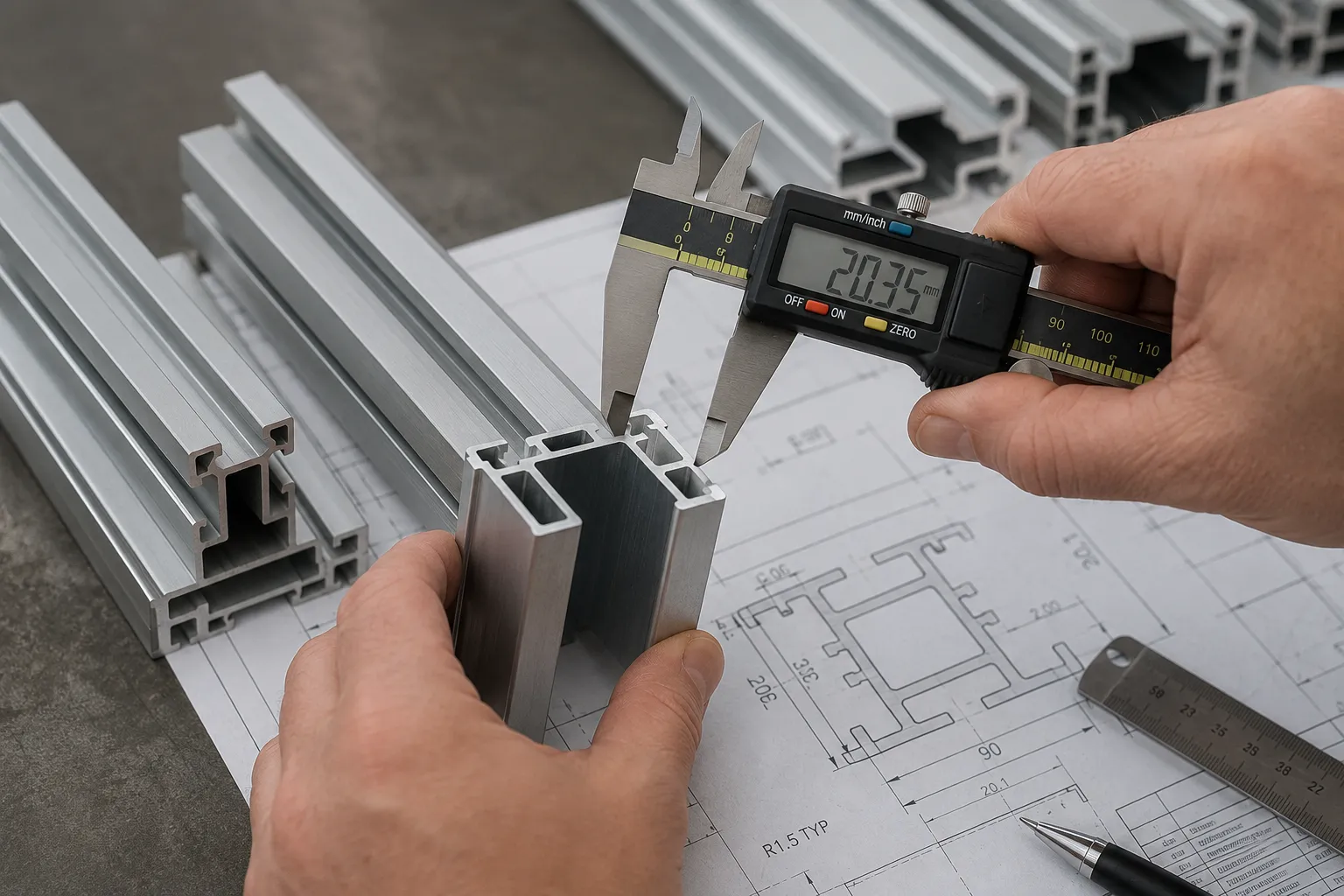
Critical features may include:
- Sliding interfaces
- Gasket grooves
- Screw ports
- Snap-fit connections
- Bearing or locating surfaces
- Sealing faces
- Mating components
- Machined reference surfaces
Only functionally important dimensions should normally be tightly controlled. Applying unnecessarily close tolerances across the entire profile can increase tooling complexity, die-correction work, inspection time, scrap, cost and lead time.
Where a highly precise surface is required, secondary machining may be more economical and repeatable than specifying an unusually tight as-extruded tolerance.
The drawings should also clarify whether the stated dimensions and tolerances apply to the extrusion directly after production or to the finished component after cutting, machining or other fabrication.
Finish and Surface Requirements
Finish requirements affect appearance, corrosion resistance, handling, processing and cost. Extal offers access to powder coating and anodising services through trusted suppliers, in addition to mill-finish aluminium.
Identify the required finish at the quotation stage and mark all visible or presentation faces on the drawing.
Anodising
For anodised aluminium, provide:
- Required anodic thickness
- Colour
- Matt, satin or bright appearance
- Applicable project standard or specification
- Visible faces
- Cosmetic expectations
- Environmental exposure
- Any sealing, testing or warranty requirements
If colour consistency is important, state whether the finish must match an approved sample or remain within an agreed colour range. The appearance of anodised aluminium can be influenced by the alloy, surface condition and production batch, so expectations should be established before production.
Powder Coating
For powder-coated aluminium, provide:
- Powder manufacturer and colour name
- RAL or another recognised colour reference, where applicable
- Gloss level
- Smooth or textured appearance
- Interior or exterior use
- Required coating system or project specification
- Warranty or durability requirements
- Visible or presentation faces
- Areas that must remain uncoated
Non-standard colours, specialist textures and multi-layer systems may involve additional setup, minimum batch quantities or longer lead times.
Visible Faces and Environmental Exposure
Marking visible faces helps the extrusion manufacturer and finisher plan handling, racking, contact points, masking and protective film. Concealed surfaces may be able to accept normal production or handling marks, but this should not be assumed where appearance is important.
The request should also describe the service environment, including:
- Proximity to the coastline or salt water
- Airborne salt exposure
- Industrial pollutants
- Exterior weather exposure
- High humidity or condensation
- Cleaning chemicals or splash exposure
- Contact with dissimilar materials
- Maintenance and warranty expectations
The appropriate pretreatment and coating system depends on the actual exposure conditions, product specification and warranty requirements. Distance from the coast should not be treated as the only measure of environmental severity.
Secondary Fabrication and Assembly
If the extrusion requires additional processing, include it in the quotation request. Secondary fabrication can significantly affect unit pricing, tolerances and production time.
Common requirements include:
- Precision cutting
- Drilling and punching
- Routing or CNC machining
- Milling and tapping
- Countersinking
- Bending
- Deburring
- Welding
- Component assembly
- Inserting fasteners or hardware
- Applying protective film
- Labelling and kitting
Supply component drawings that show the position and size of holes, slots, cut-outs and machined features. For parts that must arrive ready for assembly, also identify any required hardware, inserts, brackets, seals, protective components and part-number labels.
Quantities and Required Lengths
Order quantity, production frequency and required lengths influence setup costs, material yield, scheduling and unit pricing.
Provide Realistic Quantities
State:
- Prototype quantity
- Initial production quantity
- Expected repeat-order quantity
- Estimated annual volume
- Likely order frequency
- Whether quantities are flexible
Small runs commonly have a higher unit cost because setup, handling and production scrap are spread across fewer parts. Realistic annual requirements also help determine whether custom tooling or a dedicated production arrangement is commercially suitable.
Distinguish Between Bar Lengths and Finished Cut Lengths
The request should clearly separate:
- Supplied bar lengths
- Finished cut lengths
- Tolerance on finished lengths
- Quantity required at each length
Exact cut lengths may require precision sawing, inspection and deburring. Where the design allows flexibility, asking the supplier to recommend production-friendly lengths may improve material yield and reduce waste.
For long extrusions, consider transportable length, storage space, unloading equipment and site access. For short fabricated components, specify whether the parts should be supplied loose, bundled, bagged, placed on trays or separated with protective material.
Quality, Testing and Documentation
Quality and documentation requirements should be identified before the quotation is prepared because they may affect inspection time, production controls and cost.
Depending on the application, requirements may include:
- Material certificates
- Alloy and temper traceability
- Dimensional inspection reports
- Coating or anodising certificates
- First-off samples
- First-article inspection
- Approved colour samples
- Batch identification
- Mechanical property verification
- Compliance with nominated standards
- Certificates of conformity
State the required inspection level, including whether measurements are needed for every component, a sample from each batch or only the first production run.
Where formal approval is required before full production, allow for sample manufacture, inspection and client sign-off in the requested programme.
Packaging, Delivery and Project Timing
Delivery expectations and project context help the supplier plan production and provide a more realistic lead time.
Include:
- Required delivery date
- Delivery address
- Whether the date is fixed or flexible
- Prototype and production delivery dates
- Phased or call-off delivery requirements
- Preferred packaging method
- Protective film or surface separators
- Bundle-weight or pallet restrictions
- Part numbers, barcodes or batch labels
- Site-access and delivery-time restrictions
- Forklift, crane or unloading requirements
- Multiple delivery locations
- Export packaging or documentation
Use a specific date or delivery window rather than terms such as “urgent” or “as soon as possible.” If the required date cannot be met in a single delivery, staged quantities or revised batch sizes may be possible, subject to availability and production capacity.
A brief project description is also helpful. Explain whether the extrusion will be installed directly, fabricated further or assembled with other components. Include any interfaces, installation constraints or project milestones that may affect supply.
Aluminium Extrusion Quote Checklist
Before submitting a quotation request, confirm that it includes:
- A dimensioned profile drawing
- CAD files, where available
- Maximum profile width and height
- Wall thicknesses
- Critical features and tolerances
- Standard or custom-profile requirements
- Required alloy and temper
- Intended use and environmental exposure
- Finish, colour and performance requirements
- Visible and cosmetic surfaces
- Secondary fabrication requirements
- Supplied and finished lengths
- Initial, repeat and expected annual quantities
- Inspection and certification requirements
- Packaging and labelling instructions
- Delivery address and required date
- Site-access or unloading restrictions
Providing this information at the enquiry stage allows Extal to prepare a more accurate quotation and identify possible design, supply or production issues early. Contact Extal with your drawings and project requirements to discuss suitable standard or custom aluminium extrusion options.

